


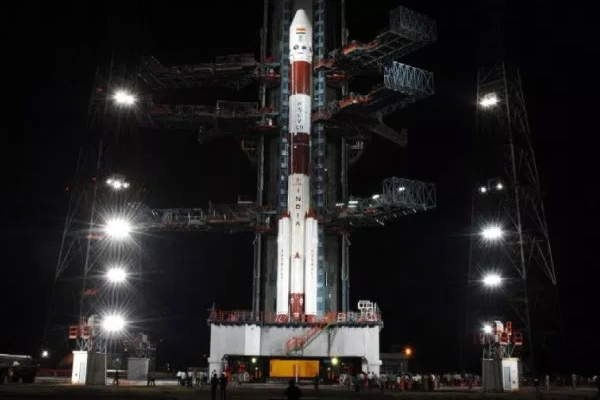

The race for the moon is back on – and Asia has an early lead. Already this year China has landed Chang’e-4 on the far side of the moon, while Israel’s Beresheet is currently in lunar orbit and scheduled to put a lander on its near side on April 11. Now India is on the cusp of making a daring attempt to land on the near side of the moon close to its south pole.
What is Chandrayaan-2?
Chandrayaan-2 (chandrayaan means ‘moon vehicle' in Sanskrit) is an ambitious mission from the Indian Space Research Organisation (ISRO) that involves an orbiter and a lander, the latter of which will unleash a lunar rover called 'Vikram’ to take measurements and map the surface.
Like Israel’s Beresheet, Chandrayaan-2 will put a NASA-owned laser reflector on the moon’s surface, which will help NASA take precise measurements of the distance to the moon.
Although it's been beset with delays, the launch window is now open for Chandrayaan-2 to blast-off from the Satish Dhawan Space Center in Sriharikota, Andhra Pradesh. Chandrayaan-2 will be carried into space by an Indian-made three-stage GSLV Mark III rocket worth about $60 million (roughly £45 million, AU$85 million).
"I've been told that the mission will launch in the next few months, though there is no firm date," says Pallava Bagla, Science Editor at New Delhi Television and correspondent at Science. "But the scientific payloads are ready."
"The mission life is one lunar day," says Bagla of the solar-powered lander and rover. "It has to land just when the moon is full and it will last 14 days so that it can use the entire solar cycle to do its work.”
Read More...


